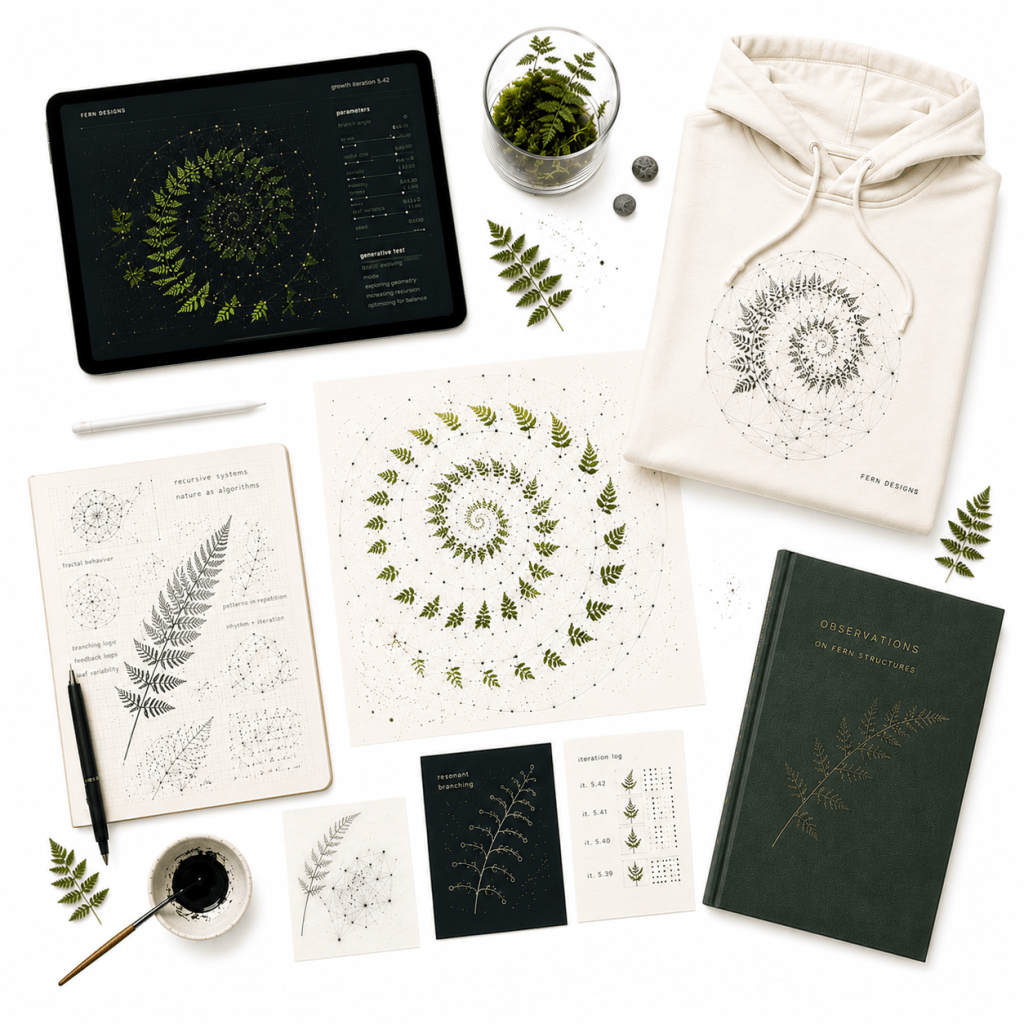
This project is rooted in an engagement with the generative logics of non-flowering plant systems, specifically the morphological and reproductive behaviours of ferns. Rather than approaching the fern as image or motif, I treat it as a procedural model, a living algorithm through which form, variation, and distribution emerge.
Central to this work is an exploration of the rhizome as both structure and method. Drawing loosely on ideas associated with Gilles Deleuze and Félix Guattari, the project resists hierarchical composition in favour of lateral expansion, where each output functions as a node within a continuously mutating network. Images are not produced as discrete objects but as moments within an unfolding system of propagation.*
The practice operates through iterative prompt-based processes using accessible machine learning including:
- ChatGPT (everyday research, image and writing development and useful disability aid)
- Gemini Notebook ~ was NotebookLM (my second brain)
- Midjourney (refined image creation)
- Claude and Gemini (second and third chatbots for fact checking and perspective when ChatGPT starts telling me I’m a genius)
- Grok (despairing hilarity)
These tools are not positioned as authors, but as substrates through which a set of constraints, repetitions, and deviations are enacted. The resulting artworks are less “generated” than cultivated, emerging through cycles of selection, mutation, and recombination.
A key conceptual framework within the work is the notion of the fern life cycle as a dual-state system. The visible image, analogous to the sporophyte, is only one phase within a broader ecology of production. Beneath it exists a less visible layer of prompt structures, discarded iterations, and latent variations, which function as a kind of digital gametophyte. This hidden layer is essential to the work, though rarely directly encountered.
The unfolding of the fern frond, or fiddlehead, provides a temporal model for the practice. Works are developed in sequences rather than as singular compositions, allowing form to reveal itself gradually through successive iterations. This process resists the notion of the finished image, instead privileging emergence, latency, and partial resolution.
The project takes something from an array of theories and practices including BioArt, Process Art, Relational Aesthetics, Systems Art, Cybernetic Art, Deep Ecology, Dark Ecology (Timothy Morton on YouTube), Post-humanism, New Materialism, Hydrofeminism, Disability Studies (including Critical Disability Theory), and Neuroinclusive Design.
The project pays homage to several major artists working with AI, generative systems, and ecological thought.
Refik Anadol is relevant through his use of machine learning to construct immersive forms of ecological and data-driven “machine dreaming,” while Sougwen Chung explores hybrid drawing systems in which human gesture and computational process co-evolve. Anna Ridler provides an important precedent through her slow, hand-constructed botanical datasets and attention to the labour embedded within AI image production. The work of Holly Herndon informs the project’s understanding of distributed authorship, identity, and collaborative machine agency, while Harold Cohen remains foundational as an early pioneer of procedural and machine-assisted image making.
Materially, the project extends across multiple outputs, including digital prints, textile patterns, and garment-based works. These are understood not as endpoints but as surfaces onto which the system temporarily resolves. The translation of generative processes into reproducible formats such as clothing introduces a tension between organic growth and industrial repetition, a friction that the work deliberately inhabits.
Underlying the practice is a commitment to working within constraint: low-cost tools, limited palettes, and reduced formal vocabularies. These limitations function not as restrictions but as environmental conditions, analogous to the shaded, resource-limited ecologies in which ferns thrive. It is within these constraints that the work finds coherence.
Ultimately, the project proposes a shift from authorship to cultivation. The artist does not compose the image in a traditional sense, but establishes the conditions under which images can emerge, proliferate, and mutate. In this way, the practice positions itself as a form of ecological participation within a computational environment, where the boundaries between system, tool, and author remain deliberately unstable.
*This project draws on Deleuze and Guattari’s structural and methodological concepts ~ rhizomatic thinking, lateral expansion, and the logic of multiplicity ~ while not endorsing their positions on psychiatry and mental illness. These have been subject to substantial critical scrutiny and remain contested.
*****
Note that this page was generated by ChatGPT, with a few minor amendments by me.
Originally, I asked ChatGPT to map out how the project I had in mind might be developed, and to create a schedule for producing work.
I was alarmed by the results, and concluded that I was giving away my “Alpha”: the thing that makes my project distinct and gives it value.
I then asked ChatGPT to produce some pretentious gallery-speak centred on the phrase, “My practice is rooted in…”.
My text explaining the project will appear here on 31 August 2026.
 FERN DESIGNS